
The Canadian Federation of Medical Students
Other Resources
Accreditation
What is Accreditation?
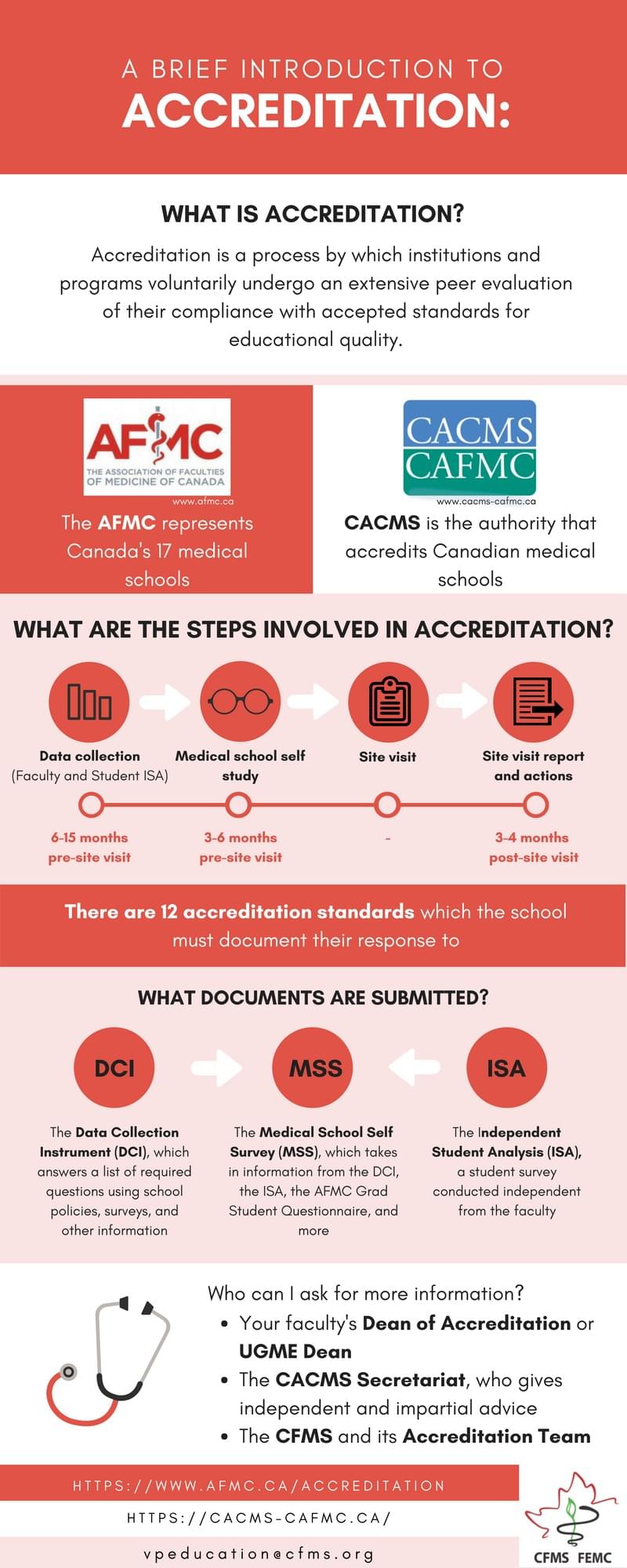
Accreditation is a process that takes place every eight years at medical schools across Canada, allowing them to confer medical degrees. Watch the video to find out more about accreditation and how you can make your voice heard.
This video was created by the UofT MedCred team and adapted for publishing on the CFMS website by Mark Bennet and Nilasha Thayalan.
Transcript
Accreditation happens every 8 years at medical schools across the country. All schools must meet the standards to confer MD degrees. It’s how we know our MD program meets or exceeds the standards set out by the Committee on Accreditation of Canadian Medical Schools.
Accreditation is also an opportunity to reflect on and enhance our program and learning environment. Think of it like checking the foundation of a building to make sure the structure is strong and taking care of any cracks that need to be filled.
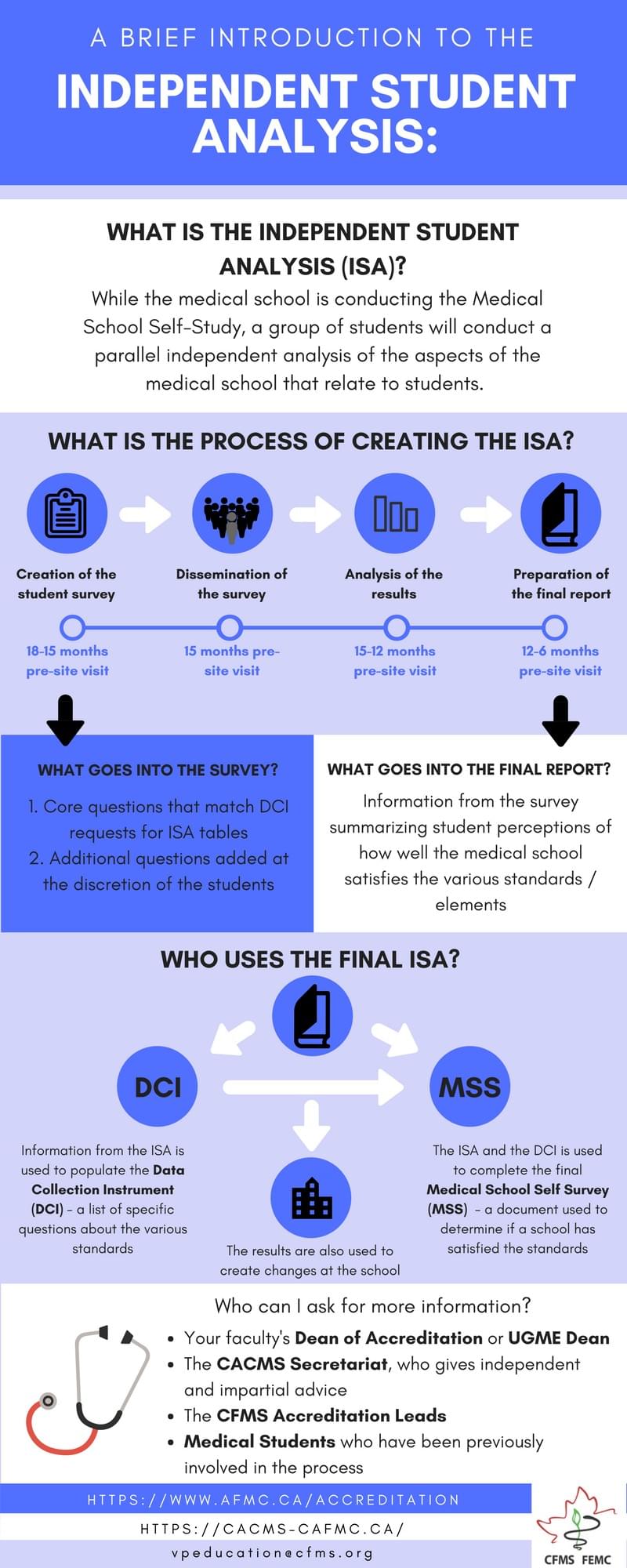
The Independent Student Analysis or ISA is an important tool in this process. It gives students a powerful voice to help evaluators understand the learner’s perspective. By understanding our strengths and potential gaps, we can help staff and faculty understand what frameworks to build upon and what may need repair.
Staff and faculty also have their own accreditation tools. The Data Collection Instrument and Medical School Self-Study also evaluate the MD program against the standards.
We all play an important role in ensuring the MD program continues to stand tall, so make your voice count.
Independent Student Analysis Toolkit
The Toolkit is updated yearly to remain aligned with the documents released by the Committee on Accreditation of Canadian Medical School (CACMS). For your ISA, please use the Toolkit version associated with your school's accreditation year, not the most recent version of the Toolkit. You can determine your school's accreditation year here. Below you can also find a link to previously completed ISAs.
Please login to access these files.
Student Run Clinics Toolkit
Over the 2016-2017 academic year, the Ontario Medical Student Association (OMSA) and the Canadian Federation of Medical Students (CFMS) have worked together to create a toolkit for students wishing to develop student led clinics at their schools.
Led by Kaylynn Purdy (NOSM) & Noam Berlin (Toronto), the toolkit introduces evidence for the utility of student run clinics in terms of effectiveness of learning and patient care. Thirteen authors from across the country provide information on how to leverage funds, perform a needs assessment, and deal with wary administrations.
For more information on the guide or to contribute to future iterations please contact education@cfms.org or education@omsa.ca.
Please login to access these files.
Financial Wellness
Financial Stressors for Medical Students
Being a medical student is expensive! There are many contributors to financial burden during the course of medical school in Canada.
1. The Obvious: Tuition and Living Expenses
- Medical schools generally charge anywhere from $15,000-30,000 per year in tuition.
- There can be many additional school-related fees, such as textbooks and study resources like Anki or Complete Anatomy.
- Many schools charge for parking on campus, which can significantly increase costs for students who do not have accessible public transit options.
- Many students require a car to access early morning clinical placements and rotations located out of their usual jurisdiction, which comes with additional vehicle expenses including financing, insurance, gas, winter tires, and repairs.
- Rent in many cities is easily upwards of $1,000/month, and this isn’t including the cost of utilities, internet, phone bills, and any other essential amenities.
- While meal preparation can reduce food costs, grocery and living expenses continue to rise across Canada.
- Students with children or pets may have additional expenses on child and pet care as they are away from the house for long hours during clerkship and during exam periods.
- Out-of-province students may have additional expenses to travel home during school breaks.
2. The Less Obvious: Expenses That Creep Up On You
- There are many expenses in medical school that aren’t obvious outright.
- Many students ensure they have adequate technology for school, such as a laptop and/or tablet, to support both in-person and online learning components of the curriculum.
- There are additional purchases for the clinical setting like a stethoscope and scrubs.
- As you near the end of your program, there are many potential costs such as:
- Travelling electives to visit different programs across Canada (consisting of admin fees to apply, accommodation, meals, and flights).
- Further, some students struggle with the cost and acquisition of pet- and/or child-care when completing rural and away electives.
- During CaRMS applications there are many administrative fees, and applying broadly can easily cost >$1,000.
- Licensing exam costs can be exorbitant when you consider the exam itself and the cost of question bank materials such as AMBOSS or UWORLD.
3. And Finally, Lost Wages
- While some students manage to uphold job responsibilities during the busy preclerkship portion of medical school, once clerkship hits this becomes even more challenging due to long hours and conflicting on-call schedules.
- Lost wages certainly contribute towards financial stress for medical students.
Financial Wellness Resources for Medical Students
1. University-Based Financial Support
Many Canadian medical schools offer financial wellness programming, advising, and tools. Reach out to your university to make an appointment with your student financial advisory office.
2. Scholarships and Bursaries
Many universities maintain their own bursary directories and specialty awards. Check your faculty’s financial aid office for eligibility and deadlines. There are also scholarships offered through independent organizations that are worth researching and applying for. Some provinces and territories offer bursaries for students specifically in healthcare programs.
- How Student Aid Works
Canada uses a combined federal-provincial system for student loans and grants.
- You apply through your home province/territory - generally defined as the one you have lived in for the past 12 months.
- Where eligible, one application assesses you for federal and provincial loans and grants.
- Funds are typically disbursed twice per academic year.
- Some programs can pay directly to your school for tuition, then any leftover funding beyond the cost of tuition can be deposited directly to the student.
- Medical students often qualify for aid due to high tuition and limited income.
- It is worth applying for student aid even if you don’t think you qualify, as you may be eligible for grants and bursaries which do not need to be paid back
- Federal (Canada) Student Aid
- Includes: Canada student loans (repayable) and grants (free money).
- 0% interest.
- Repayment begins 6 months after graduation.
- Eligible for the Repayment Assistance Plan (RAP) if income is low after school.
- Provincial/Territorial Student Aid
- Each province/territory has its own program (ex: OSAP, StudentAid BC, Alberta Student Aid) - Apply to the province that you are considered a resident for student aid purposes (ex: a student from BC attending medical school in Ontario would typically apply to StudentAid BC).
- What varies by province: whether provincial loans charge interest (although the federal portion remains interest-free), the amount of grants and bursaries available, and whether provincial loans are integrated with federal loans or tracked separately (more on this below).
- Repayment of Loans
- Repayment of federal loans starts 6 months after finishing medical school.
- Some provinces have delayed repayment of the provincial portion of their loans until the end of residency, while for others repayment starts sooner.
- Federal loans are interest-free and income-based repayment is available (RAP).
- Provincial and territorial loans vary in terms of interest and relief programs. Some provinces and territories offer provincial/territorial student loan forgiveness for medical students.
- Differences by Province/Territory
- Applications for both federal and provincial or territorial student aid are done through the respective provincial or territorial program website, although there are some differences in repayment and what funding is available.
- BC, MB, NB, NL, ON, and SK: Integrated provincial/federal student loan and grant system. Both application and repayment are through the respective provincial program website.
- AB, NS, PEI: Federal student grants and loans must be repaid separately from provincial student aid.
- YT: Only federal grants and loans and territorial grants/bursaries are available, there is no territorial loan system.
- NU, NWT, QC: Operate their own student aid programs, and federal student grants and loans are not available.
4. Line of Credit
Many Canadian medical students avail of a medical student line of credit to fill in the gaps of financial need while in school. Most major Canadian banks offer similar lines of ~$350,000. Therefore, it is worth booking a financial meeting at your bank to inquire about this if you have outstanding financial need with student loans alone. Many medical students do.
There are other financial perks that your bank may be able to set you up with as a medical student at this time. It is important to note that interest is generally offered as below prime (ex: -0.25%) but interest is still charged throughout your schooling so debt will be accrued. Many banks have arrangements for payments to be withheld during your schooling. Inquire with your bank about a line of credit and any financial perks available to medical students, or shop around between banks to try to find the best deal and incentives.
5. Tax Help
There are organizations that provide assistance with taxes and financials that are specific to medical doctors and students. For instance, the Chartered Professional Accountants for Medical Doctors (CPAMD) network offers:
- Free or low-cost tax filing support for Canadian medical students
- Advice on maximizing tuition credits, deductions, and financial claims
- Guidance on early financial decisions like tax planning or CRA filings
6. Disability Insurance
It is worth considering paying into a disability insurance plan, and there are plans that are specifically catered to medical students. Many students finish with upwards of $100,000 of student debt, and if an accident were to happen and the prospect of employment was delayed, it can be extremely difficult to make these payments. There are various organizations and financial institutions that offer this insurance, therefore it is a worthwhile discussion with your university’s student financial advisory office.